
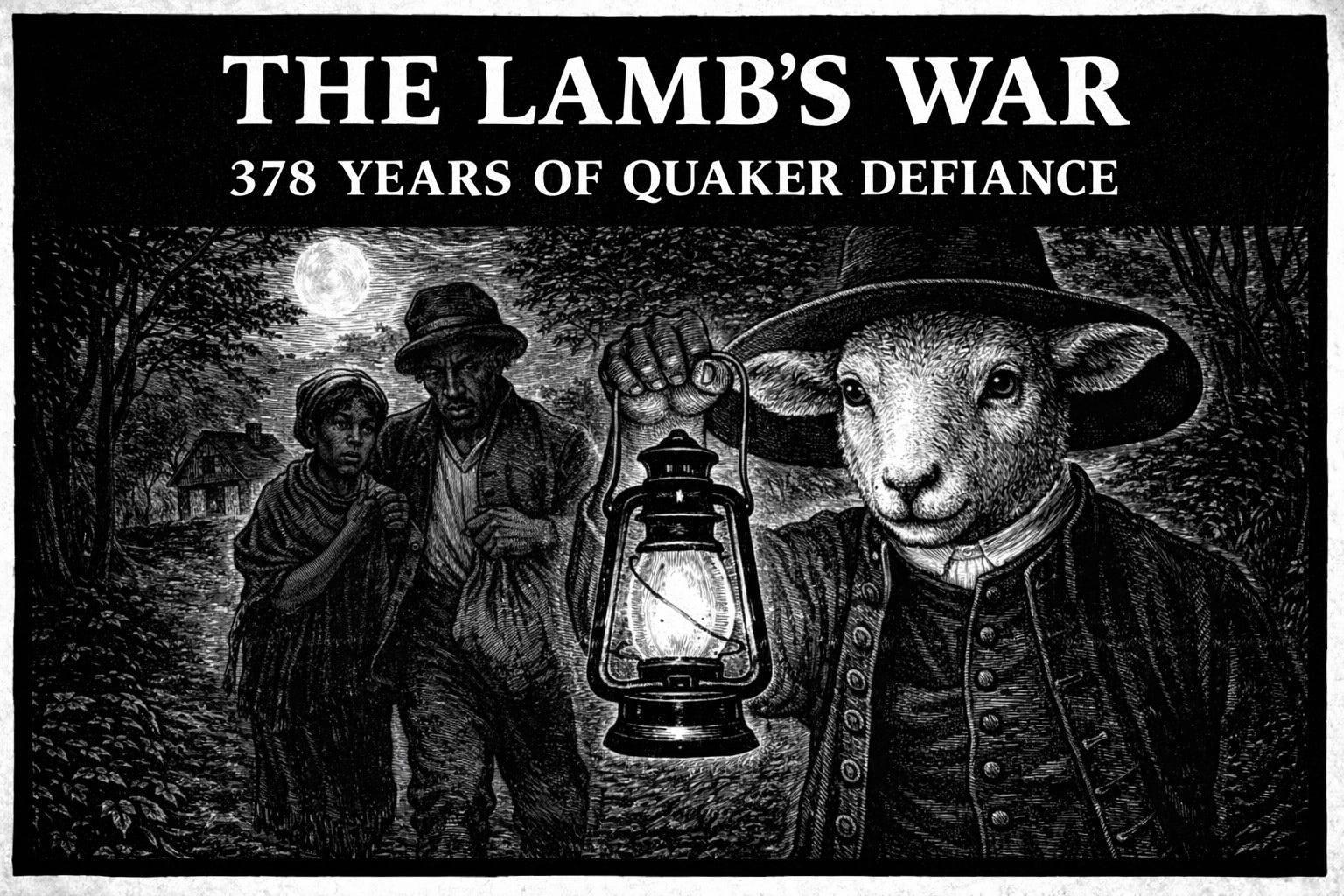
The Lamb's War
378 Years of Quaker Resistance, and Defiance to War

Here’s the merged version:
Friends -
I am happy to let you know that the video I made of the Quaker history talk (from this year’s Quakerism 101) is now up on YouTube.
We put a lot of work into it, trying to edit the video a little bit, and add some images for illustration, since the recording on 2/15/26 at 15th Street Meeting. Thanks to the support of Ministry and Worship, and everyone who gave guidance.
Link is here:
A few thoughts -
We Friends/Quakers really have a lot to contribute, as a ballast to all the times that Christians have waged war in a rage. Past and present times included. That is one of our many unique historical contributions — to rediscover the peace of the Gospels.
We have also consistently been ahead of our time in terms of pushing social progress: on equality, women’s equality, on fair treatment of the natives, on abolition, on women’s suffrage, and on civil rights. And of course, on conscientious objection, bringing us back around to the radical nonviolence at the heart of the teachings of Jesus….and Fox, Fell, Woolman, Hicks, et. al.
So….as Fox would put it — “What Canst Thou Say?”
Where do you stand in the long contradiction between the teachings of Jesus and the violence carried out in his name? When we speak of the Inner Light, do you mean that as a private comfort — or can it be a force that confronts kings, churches, and systems of domination?
The Lamb’s War: A Quaker History by Sander Hicks, Historian, 15th Street Meeting
This Quaker history begins in the furnace of civil war. George Fox emerged in a world where Christians were killing Christians and every faction claimed divine authority. He rejected the sword, rejected priestly mediation, and declared that Christ had come to teach his people himself. From that claim flowed silent worship, plain speech, refusal of oaths, and a radical insistence on equality.
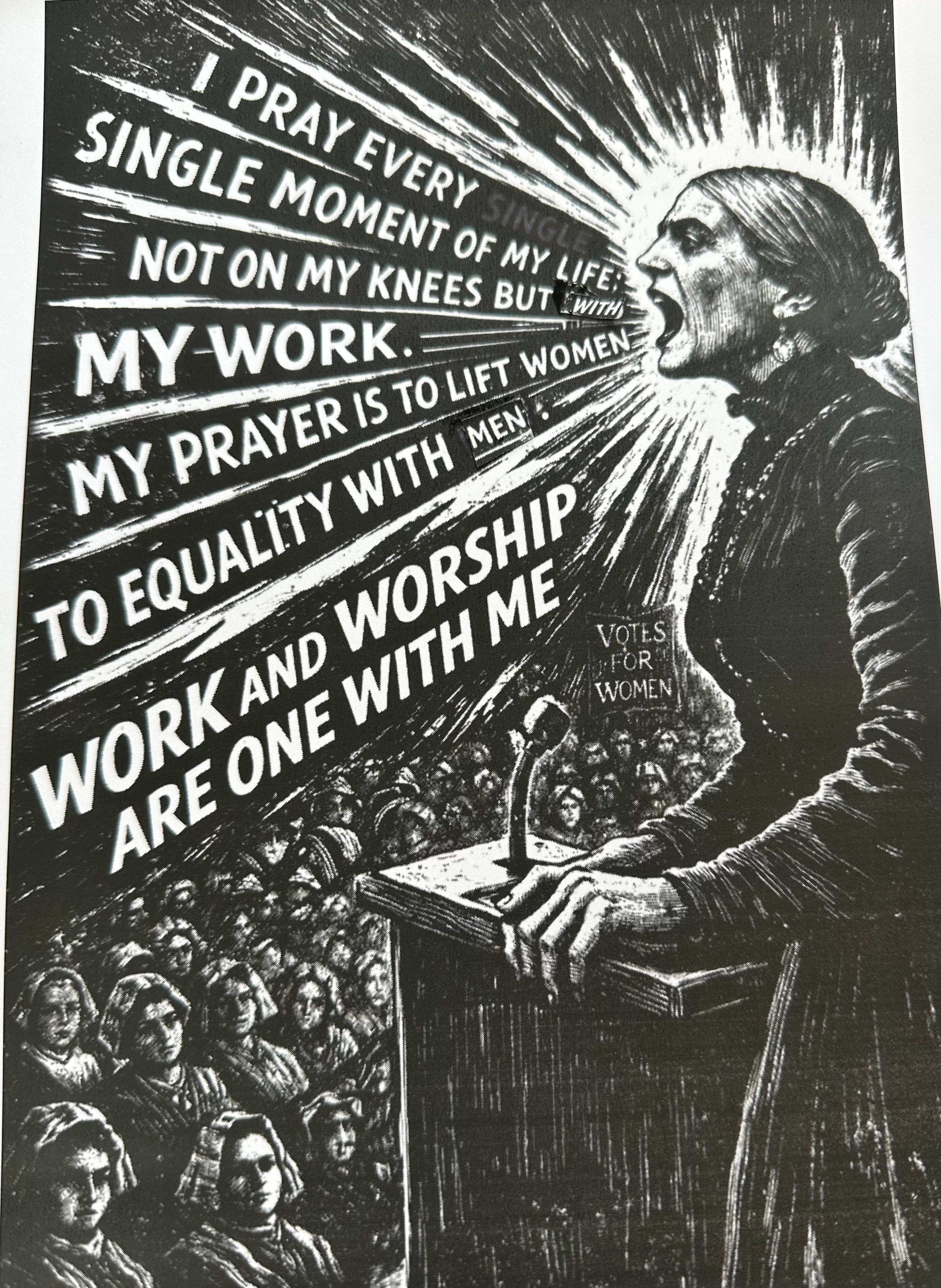
Friends carried that witness into government with William Penn, into abolition through Lay and Woolman, into schism with Elias Hicks, into women’s suffrage with Lucretia Mott and Susan B. Anthony, into civil rights with Bayard Rustin, and into war resistance through the Peace Testimony and the work of the American Friends Service Committee.
At times, Friends shaped power. At times, they were shaped by it. At times, they failed and had to reckon with their complicity. But the thread remained: conscience over coercion.
This history is not past. It is alive in this Meeting. It is alive wherever equality is practiced, wherever violence is refused, wherever truth is spoken plainly. The question is not what Fox said. The question is: what we will say now.
Recommended Further Reading
Ambler, Rex. Truth of the Heart: An Anthology of George Fox (1624–1691). Wallingford, PA: Pendle Hill Publications, 2005.
Barbour, Hugh, J. William Frost, Arthur J. Worrall, and Paul M. Peucker, eds. Quaker Crosscurrents: Three Hundred Years of Friends in the New York Yearly Meetings. Syracuse, NY: Syracuse University Press, 1995.
Newman, Daisy. A Procession of Friends. Richmond, IN: Friends United Press, 2007.
Full Bibliography
Ambler, Rex. Truth of the Heart: An Anthology of George Fox (1624–1691). Wallingford, PA: Pendle Hill Publications, 2005.
Barbour, Hugh, J. William Frost, Arthur J. Worrall, and Paul M. Peucker, eds. Quaker Crosscurrents: Three Hundred Years of Friends in the New York Yearly Meetings. Syracuse, NY: Syracuse University Press, 1995.
Barry, Kathleen. Susan B. Anthony: A Biography of a Singular Feminist. New York: New York University Press, 1988.
Boulton, David. “Militant Seedbeds of Early Quakerism: Gerrard Winstanley and the Digger Tradition.” Diggers.org. Accessed February 2026. https://www.diggers.org/quakers_and_d....
Brinton, Howard H. Friends for 350 Years: The History and Beliefs of the Society of Friends Since George Fox Started the Quaker Movement. Wallingford, PA: Pendle Hill Publications, 2002.
Cox, John, Jr. Quakerism in the City of New York, 1657–1930. Illustrated paperback ed. New York: Friends Historical Library / Quaker Press, 2011.
Densmore, Christopher. Quakers and the Underground Railroad: Myths and Realities. Commentary. Friends Historical Library, Swarthmore College. Accessed January 9, 2026.
Forbush, Bliss. Elias Hicks: Quaker Liberal. New York: Columbia University Press, 1956.
Foster, Richard J., and Emilie Griffin, eds. Spiritual Classics: Selected Readings on the Twelve Spiritual Disciplines. San Francisco: HarperSanFrancisco, 2000.
Fox, George. George Fox’s “Book of Miracles.” Edited by Henry J. Cadbury. Forewords by Rufus M. Jones, Jim Pym, and Paul Anderson. 3rd ed. Philadelphia: Friends General Conference; London: Quaker Home Service, 2000.
Fox, George. The Journal of George Fox. Edited by Norman Penney. New York: Cosimo Classics, 2007.
Hicks, Rachel. Memoir of Rachel Hicks, Written by Herself; Together with Some Letters and a Memorial of Westbury Monthly Meeting. New York: G. P. Putnam’s Sons, 1880.
Jones, Sabrina. Radical Jesus: A Graphic History of Faith. Seattle: Fantagraphics Books, 2023.
Jones, T. Canby. George Fox’s Attitude Toward War: A Documentary Study. Richmond, IN: Friends United Press, 1984.
New York Yearly Meeting of the Religious Society of Friends. Faith and Practice: The Book of Discipline of the New York Yearly Meeting of the Religious Society of Friends. Revised 2020 ed. New York: New York Yearly Meeting, 2020.
Newman, Daisy. A Procession of Friends. Richmond, IN: Friends United Press, 2007.
Velsor, Kathleen G. The Underground Railroad on Long Island: Friends in Freedom. Jefferson, NC: McFarland & Company, 2015.
Woolman, John. The Journal and Major Essays of John Woolman. Edited by Phillips P. Moulton. New York: Oxford University Press, 1971.